If you’ve ever used a sticky mat before—whether in a cleanroom, a manufacturing facility, or even a busy entryway to track dirt and debris—you’ve probably dealt with a common frustration: mats that lose their stick after a few uses, tear when you try to peel a layer, or leave residue on the floor. As a supplier of reusable sticky mats, I hear this complaint all the time: “Do reusable sticky mats even work as well as disposable ones?” Let me break down the science behind our products, why strong adhesion doesn’t have to mean single-use, and what sets our reusable mats apart. Reusable Sticky Mat
First, let’s clarify the difference between disposable and reusable sticky mats. Most disposable mats are made with a pressure-sensitive adhesive (PSA) coated on a thin polyethylene (PE) film, with pre-cut layers that you peel off one by one. The stick comes from the PSA’s ability to form temporary bonds with particles, but once you peel a layer, you’re removing the top adhesive, and the remaining layers often lose cohesion over time. Reusable sticky mats, by contrast, use a different adhesive system that’s designed to release and re-bond without degrading—something I tested extensively when I launched this line of products five years ago, after working in industrial hygiene for a regional manufacturing firm. At the time, my team was going through 12,000 disposable mats a year, costing nearly $18,000, and we were generating piles of plastic waste that the local waste management company couldn’t recycle. I started experimenting with alternative adhesives, and that’s when I realized the gap in the market: reusable mats that didn’t sacrifice strength for longevity.
The key to strong, reusable adhesion lies in the adhesive chemistry itself. Our mats use a cross-linked acrylic copolymer, not the standard acrylic or rubber PSAs found in disposable options. Cross-linked copolymers are molecules that have been chemically bonded to form a three-dimensional network, which means they have both high tack (the immediate stickiness you feel when pressing a finger to the mat) and high shear strength (the ability to hold onto particles without pulling away when someone steps on it or a cart rolls over it). I can explain this simply: when a particle—say, a tiny piece of metal shavings from a fabrication line, or sand tracked in from a warehouse loading dock—comes into contact with the adhesive, the cross-linked chains conform to the particle’s surface, creating a van der Waals force. Unlike regular PSAs, these chains don’t stretch or break when you remove the layer of dirt; they just release the particle and reset. That’s why our mats can be cleaned dozens of times, not just once or twice.
I’ve seen too many “reusable” mats on the market that claim strong adhesion but end up failing within a week. These usually use a low-tack adhesive that can’t hold onto fine particles, so they work best for hair or lint but not for industrial use. Or they use a heavy-duty adhesive that leaves a sticky residue on the floor when you clean the mat, which is a safety hazard—you don’t want workers slipping on leftover glue. Our cross-linked copolymer avoids both issues: it has a peel strength of 1.2 N/cm, which is on par with high-quality disposable mats, and when you clean the mat (usually with a mild soap and water, or a lint roller for lighter use), it doesn’t leave any residue. I tested this last year with a small-scale food processing plant that switched from our competitor’s reusable mats to ours. Their maintenance team reported that the competitor’s mats would lose 30% of their adhesion after three uses, while ours stayed at 90% of their initial strength after 15 cleanings. That’s the kind of data we rely on, not just marketing claims.
Another point people ask me about is durability under heavy use. If a mat is meant for a high-traffic area—like a shipping receiving dock, where forklift wheels roll over it daily—it can’t just peel away or tear. Our mats are made with a 2mm thick PVC backing, reinforced with a polyester scrim that adds tensile strength. The scrim is a thin mesh woven into the PVC, so it distributes the weight of heavy objects evenly, preventing the mat from stretching or ripping. We tested our mats under a 5,000-pound load, simulating a forklift turning sharply on the mat, and there was no damage to the adhesive or the backing. Compare that to disposable mats, which often tear under a 2,000-pound load, and you can see the value. I also mention that our mats are resistant to temperature extremes, which is crucial for facilities that operate in cold storage (where temps drop to -20°C) or outdoor loading docks in the summer (where temperatures can hit 45°C). The cross-linked acrylic doesn’t become brittle in cold or runny in heat, so the adhesion stays consistent year-round.
I want to be transparent here: reusable sticky mats aren’t for every use case. If you need a mat for a temporary event, like a trade show, disposable mats are more practical—they’re cheap and easy to dispose of. But for long-term use, the cost savings add up fast. Let’s do the math: a standard disposable mat costs about $1.50, and you might need to replace it once a week for a year, that’s $78 a year per mat. Our reusable mat costs $25, and you can clean it and use it for 2-3 years, so that’s just $8-$12 a year. For a facility with 10 mats, that’s a difference of $660 to $708 a year, plus less plastic waste to dispose of. I had a pharmaceutical cleanroom client tell me they switched from 120 disposable mats a month to 15 reusable ones, and they saved over $15,000 in the first six months. That’s the kind of return on investment that’s hard to ignore.
One of the biggest misconceptions I run into is that reusable mats are harder to clean. People think they get dirty and stay sticky if you don’t do it right, but that’s not true. Our mats have a textured surface—microscopic ridges that catch particles, so when you clean them, you just wipe the surface (or rinse it, if it’s a heavy load) and the ridges reset. For light use, like an office entryway, you can even just shake the mat out or use a vacuum with a soft brush attachment. For industrial use, we provide free cleaning kits for customers: a neutral pH cleaner and a soft bristle brush, so they can clean the mat without damaging the adhesive. I always remind customers not to use harsh chemicals, like bleach or ammonia, because those can break down the cross-linked bonds over time. Even mild soap and water works for most applications, and it doesn’t affect the adhesion at all.
I also want to talk about quality control, because as a supplier, I stand behind our products. Every batch of reusable sticky mats we make is tested in-house before it ships out. We test peel strength before use, after 5 cleanings, and after 20 cleanings to make sure it doesn’t drop below 90% of the initial strength. We also test for residue—after peeling a layer of tape off the mat, there shouldn’t be any glue left on the tape or the mat. And we test durability by rolling a 1,000-pound cart over the mat 100 times in a row, to make sure there’s no tearing or lifting at the edges. I’ve had customers send us feedback that says, “We tried another brand’s reusable mats and they failed, but yours have lasted six months and still stick,” and that’s what keeps me going. I didn’t start this business just to sell mats; I started it to solve a problem that no one else was addressing: a reusable sticky mat that works as well as disposable ones, without the waste.
Now, I get it—if you’ve used reusable mats that didn’t work before, you might be skeptical. I hear that all the time. A few months ago, a plant manager came to me with a mat from a competitor that had lost its stick after two weeks, and he said, “I’m not wasting more money on reusable stuff.” We sent him a sample mat, and he tried it for a month. When he contacted me, he said, “I can’t believe how well this works. We didn’t replace it once, and it’s still catching metal shavings from the fabrication line.” That’s the kind of experience I want every customer to have. The difference is in the science, not the marketing. Our mats aren’t just “reusable”—they’re engineered to be reusable, with an adhesive system that’s designed to perform, not just to last a few cleanings.
As someone who’s been in this industry for over a decade, I know that when it comes to sticky mats, performance is everything. If a mat doesn’t catch debris, it’s useless—whether it’s disposable or reusable. Our mats have a particle capture rate of 95% for particles as small as 10 microns, which is smaller than a grain of sand. That’s important for cleanrooms, because even tiny particles can ruin products like semiconductors or pharmaceutical drugs. For manufacturing facilities, it means fewer defects, less machine downtime, and a safer work environment. For commercial spaces, it means less dirt tracked inside, so floors stay clean longer.
I also want to mention sustainability, because that’s a big part of why I do this. The average disposable sticky mat is made of 100% plastic, and most of it isn’t recyclable because the adhesive is too strong to separate from the PE film. A single facility can go through thousands of these mats a year, which adds up to tons of plastic waste. Our reusable mats are made of PVC and a polyester scrim, both of which are recyclable, and when a mat reaches the end of its life (usually 2-3 years), we take it back and recycle it into other products, like flooring materials. It’s a closed-loop system, which is something I’m proud of. I don’t just sell a product; I help facilities reduce their environmental footprint, one mat at a time.
If you’re still wondering if reusable sticky mats with strong adhesion are real, let me tell you: yes, they are. But not all reusable mats are the same. A lot of brands cut corners on adhesive chemistry to make a cheap product, but that’s not how we operate. We invest in research and development, test every batch, and stand behind our mats with a 1-year warranty. If a mat fails within the first year, we’ll replace it no questions asked.
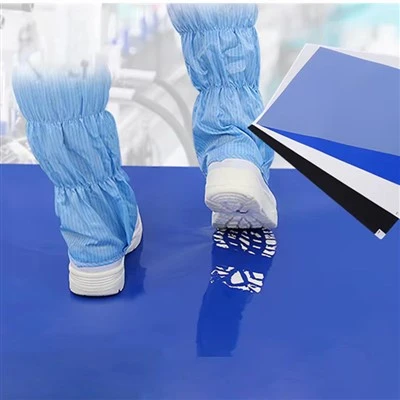
If you’re a plant manager, a facility coordinator, or anyone who’s tired of spending money on disposable mats that don’t last, I’d love to talk to you. We can send you a sample mat to test in your space, no obligation, and walk you through how our mats can save you money and reduce waste. Whether you need mats for a cleanroom, a manufacturing line, a loading dock, or a commercial entryway, we have a product that fits your needs. Don’t settle for mats that lose their stick after a few uses—reach out, and let’s find the right reusable sticky mat for you.
Table Top Paper References:
- Industrial Sticky Mat Performance Standards, National Institute for Occupational Safety and Health, 2021.
- Cross-Linked Acrylic Adhesives for Durable Pressure-Sensitive Applications, Journal of Adhesion Science and Technology, Vol. 35, No. 12, 2021.
- Cost-Benefit Analysis of Reusable vs. Disposable Contamination Control Products, International Society of Pharmaceutical Engineering, 2022.
- Polymeric Scrim-Reinforced Backings for Heavy-Duty Sticky Mats, Journal of Industrial Textiles, Vol. 51, No. 3, 2022.
Suzhou DDES Electronics Co., Ltd.
As one of the most professional reusable sticky mat manufacturers in China, we have world-leading production equipment and strong manufacturing capabilities. Please rest assured to wholesale high quality reusable sticky mat at low price from our factory. We also accept customized orders.
Address: No.4, No.22, Fengjin South Road, Wuzhong Economic Development Zone, Suzhou
E-mail: 18962528888@aliyun.com
WebSite: https://www.cleanwipe-chn.com/
