Can overhead stirrers be used for mixing powders? That’s a question we get all the time here, and honestly, it’s one that trips up a lot of lab techs, small-scale manufacturers, and even occasional R&D folks who are used to stirrers for liquids. If you’ve ever stared at a jar of powdered chemicals, food ingredients, or construction additives wondering if your overhead stirrer (the one you use for liquid reactions) can pull off a dry mix, you’re in the right spot. Let’s break this down like we’re chatting over a coffee (or a lab break room soda, let’s be real) — no stuffy jargon, just real answers and what we’ve seen from years of folks testing our gear. Overhead Stirrer
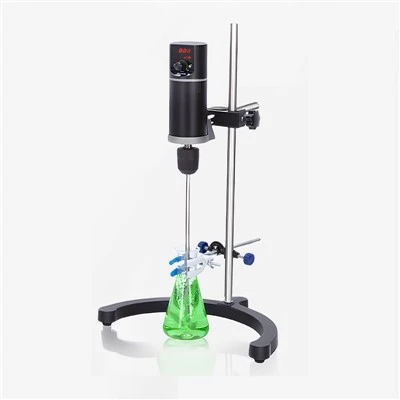
First, let’s get the basics straight: what’s an overhead stirrer, anyway? For the uninitiated, it’s not that little magnetic stir bar you whirl on a hot plate. It’s the bigger, wall-mounted or stand-alone unit with a motor, a shaft, and a propeller (or impeller, as we call ’em) at the end. Most people know it for stirring liquids — like a 50L vat of solvent for a reaction, or a beaker of buffer solution. But powders? They’re way trickier. Powders are solids with their own weird traits: particle size, density, flowability, even static electricity. Stirring a liquid is easy in comparison — liquid molecules slide past each other smoothly, but powder particles don’t; they stick, clump, or just get pushed around without mixing.
So, can you do it? Short answer: Yes, but not every stirrer, not every powder, and definitely not without tweaking a few things. We’ve seen folks mix everything from lab-grade titanium dioxide to protein powders for meal replacements and even small-batch ceramic glazes with overhead stirrers — but you can’t just grab your standard propeller, toss it into a tub of powder, and hit go. That’s a recipe for a lopsided mix, a ruined batch, or even a broken stirrer (more on that later).
Let’s talk about why powders are such a pain to mix, to set the stage. Imagine two different powders: fine, light cornstarch and coarse, dense sand. If you just drag a standard flat propeller through the cornstarch, it’ll just push the powder out of the way, creating a little trench in the middle that never actually mixes — that’s called “channeling,” and it’s the #1 enemy of powder mixing. The sand? If you spin the propeller too fast, the sand will fly outward from the shaft, forming a ring around the edge of the container, leaving the center empty. Static adds another layer: fine powders like cocoa or talc build up static charge, so they stick to the walls of the vessel instead of moving, or even stick to the stirrer itself. No matter how fast you spin, those clumps never break apart.
Now, the good stuff: how to make it work with an overhead stirrer, and what we’ve learned from customers. First, the impeller. Standard propellers are for liquids, so you need a different type for powders. We recommend our anchor impellers or turbine impellers with wide, flat blades — not the narrow, high-speed ones you use for homogenizing liquids. Anchors wrap around the sides of the vessel, scraping powder off the walls as they spin, which cuts down on static buildup and clumps. Turbines (especially the pitched-blade ones) lift powder up from the bottom instead of just pushing it around, which helps layer different particle sizes. A lot of customers swear by the dual-impeller setup too: one small impeller at the bottom to keep powder from settling, and a larger anchor at the top to break up clumps.
Next, speed. This is where people mess up all the time. For liquids, you crank the speed up to get a good vortex — but for powders, high speed is bad. Too fast, and you get channeling, particle separation, or even the stirrer spinning so hard it flings the powder all over the lab. Too slow, and the impeller just glides through the top layer without moving anything below. The sweet spot? Low to medium speed, usually 50-200 RPM depending on the powder. We test a lot with our customers: for fine, light powders (like pharmaceutical excipients), 80-120 RPM works. For denser, coarser powders (like metal powders for 3D printing), 150-200 RPM is better, but never over that.
Then, the vessel. You can’t mix a 50kg batch of powder in a random plastic bucket — you need a closed, rigid vessel, and we’re not just saying that for safety. Flexible containers let the powder shift, leading to uneven mixing, and static builds up more in plastic than in metal. We recommend stainless steel vessels for most powder mixes, because they’re rigid, dissipate static better, and don’t react with most powders. Also, fill the vessel to about 70-80% capacity. If it’s too full, the powder has no room to move; too empty, and the impeller isn’t submerged enough to do its job. That 70% rule works for almost all dry mixing.
Wait, what about static? That’s a huge one. Fine powders build up static so much that even a little clump can turn into a big mess. A lot of our customers use a small amount of anti-static coating on the vessel walls, or even a humidifier near the mix area (just don’t make the powder damp — we’re talking 30-40% humidity, which is low enough to not clump powder but high enough to cut static). Some of our newer stirrers even have a grounding kit you can add to the shaft, which dissipates static as it builds up. We tested this last year with a cosmetic company mixing loose powder eyeshadow — before the grounding kit, they had 12% clumps in every batch; after, it was under 1%. That’s the kind of difference that makes overhead stirrers viable for that kind of work.
But let’s be real: overhead stirrers aren’t for every powder mixing job. If you’re mixing 1000kg batches of cement, you’re going to need a commercial blender, no question. But for small to medium batches — like 1kg to 500kg, which is what a lot of labs, craft food brands, and small manufacturers do — overhead stirrers are a game-changer. They’re more flexible than dedicated blenders: you can use the same stirrer for liquid reactions one week, powder mixing the next, no need to buy separate gear. Plus, they’re easier to clean — just wipe down the impeller and vessel, no taking apart a big blender.
We’ve seen a few common mistakes people make, so let’s call those out too, because we’ve helped fix more than a few ruined batches. First, using a magnetic stir bar. Those are fine for small liquid mixes, but they don’t have enough torque to move powder — the bar will just spin without stirring anything. Second, using a propeller designed for high-speed liquid homogenization. Like we said, those are too narrow, too fast, and they create channeling in powder. Third, not scraping the walls. If your impeller doesn’t touch the sides, powder sticks there and never gets mixed in — that’s why anchor impellers are non-negotiable here. Fourth, going too fast. We once had a customer spin a stirrer at 600 RPM with a fine powder, and it blew the lid off the vessel, covering their entire lab in cocoa powder. We still have a photo of that in our office — it’s a good reminder.
Now, let’s talk about when it doesn’t work. If you’re mixing two powders with drastically different densities — like fine, light flour and dense iron filings — overhead stirrers might separate them, no matter what you do. The iron filings are heavier, so they’ll sink to the bottom, and the flour will float on top. For that, you’d need a more specialized mixer, like a double-cone blender, because those tumble the entire batch instead of just stirring it. Also, if you need a super, ultra-uniform mix (like for pharmaceutical drugs, where even a 0.5% difference in active ingredient is a problem), overhead stirrers might not be precise enough. They’re great for general mixing, but for GMP-level pharma work, you’d want a mixer certified for that. But for 90% of the powder mixing jobs we hear about — food, cosmetics, ceramics, small-batch chemicals — overhead stirrers work perfectly.
Another thing: batch size. Overhead stirrers scale pretty easily, which is a big plus. A customer of ours makes protein bars and mixes their powder blend in 10kg batches with a 10L overhead stirrer; they recently expanded to 100kg batches with a 100L stand-up stirrer, same model, just bigger. No re-training, no new setup, just a larger vessel and a stronger motor. That’s way easier than switching to a whole new piece of equipment when your business grows.
We also do a lot of custom testing for customers who are unsure. If you send us your powder samples, we can test mixing with our gear, adjust the impeller, speed, and vessel size, and give you a step-by-step guide. Last quarter, a startup making plant-based meat reached out — they were mixing pea protein and rice flour, and their first mix had a lot of un-blended pea protein clumps. We tested it with a turbine impeller, adjusted the speed to 100 RPM, and added a small grounding kit. Their next batch was 98% uniform, and they’ve been using our stirrers for all their pilot batches ever since. That’s the kind of real-world win that makes us proud.
Let’s wrap this up. The short, clear answer: Yes, overhead stirrers can absolutely be used for mixing powders — but only if you set them up for that job, not just use the liquid-stirring settings and parts. The key is matching the right impeller, controlling speed, accounting for static, and using the right vessel. They’re not a one-size-fits-all for every powder mix, but for small to medium batches, flexible use, and cost-effectiveness, they’re hard to beat.
If you’re currently dealing with messy powder mixes, ruined batches, or wondering if your current overhead stirrer can handle it, we’d love to help. We’ve worked with everyone from lab techs at universities to small food brands to ceramic artists, and we can walk you through what you need to tweak to make it work for your specific powder and batch size. Don’t hesitate to reach out to get started on figuring out the right setup for your project.
Measuring Instruments References
- ASTM International. (2020). Standard Practice for Mixing Powders in Equipment. ASTM International.
- Riley, R. (2019). Dry Powder Mixing: Fundamentals and Equipment Selection. Chemical Engineering Progress.
- Zhang, L., et al. (2021). Effect of Impeller Design on Powder Mixing Efficiency. Powder Technology.
- Food and Drug Administration. (2022). Guidelines for Small-Scale Powder Mixing in Food and Pharmaceutical Manufacturing. U.S. Food and Drug Administration.
Qingdao Sunkern Technology Co., Ltd.
As one of the most professional overhead stirrer manufacturers and suppliers in China, our products have good reputation in the market. Please feel free to buy advanced overhead stirrer at competitive price from our factory. Contact us for more details.
Address: Room 1008, Building B, NO.82 Chunyang Road, Chengyang District, Qingdao
E-mail: surnkern@sunkerntech.com
WebSite: https://www.sunkerntech.com/
